TL;DR. Multi-view global attention is structured, not sparse: layers average over the scene, match points across images, or anchor on the first image.
2.08×faster than the released VGGT-Ω code at 50 images on an RTX 4070 SUPER: 1.61× from our CUDA engine, 1.29× from RAWATTA itself (Tab. 1, 2)
about 1 pointof pose accuracy (AUC@3) lost at most, on any of six datasets, on 10-frame sequences (RAWATTA vs released code: −1.03; Tab. 4)
200 imagesin 12.5 s on a 12 GB GPU, 1.66× faster than the exact engine; the released code runs out of memory at 100 (Tab. 2, Sec. 5.5)
Swipe the figure sideways to see panels (b) and (c) and the legend.
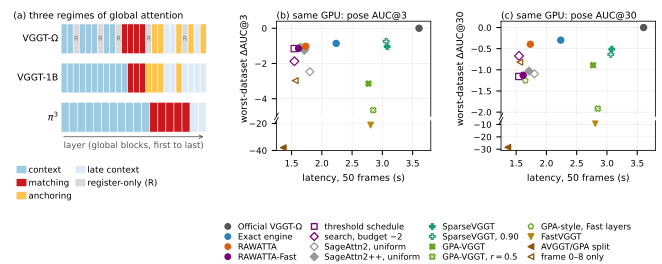
Figure 1 of the paper.(a) Global attention in multi-view transformers follows three regimes (10 frames, i.e. images, 7 datasets); VGGT-Ω attends strongly to the first (reference) frame, VGGT-1B weakly, and π³, which has no reference frame, not at all.
(b, c) On one RTX 4070 SUPER: latency at 50 frames against the change in pose AUC@3 (b) and AUC@30 (c), measured on 10-frame sequences, on the worst of six datasets, relative to Official VGGT-Ω. Filled: RAWATTA settings; hollow purple: other schedules; grey: uniform low-precision kernels; green/gold: published accelerators; brown: the AVGGT/GPA-VGGT layer split in our engine. Accelerators that merge or drop keys in matching layers lose by far the most accuracy.
Select a figure to open it at full size; on a phone, swipe wide figures sideways.
Multi-view 3D transformers such as VGGT-Ω reconstruct a scene from a set of unposed images in a single forward pass, predicting camera poses, depth and 3D points, but the cost of their global attention grows quadratically with the number of images. Accelerators borrowed from large language models assume that each token attends to only a few others; on these models they lose accuracy or gain little speed. We study the global attention of three multi-view transformers on seven datasets and find that every layer plays one of three roles: it averages over the whole scene, matches points across many images, or anchors on the first image, whose coordinates the outputs use. Building on this analysis, we propose Regime-AWare ATTention Approximation (RAWATTA), a training-free method that runs attention in 8-bit precision and keeps 16-bit precision only in the layers where a worst-case calibration check requires it. Its fast setting, RAWATTA-Fast, also approximates attention in a few averaging and anchoring layers, while matching layers and the first image keep all their keys. On a 12 GB GPU at 50 images, RAWATTA runs VGGT-Ω 2.1× faster than the released code, mostly through our CUDA engine, and loses at most about one point of pose accuracy (AUC@3) on any dataset; RAWATTA-Fast is slightly faster and less accurate. Both fit 200 images, where the released code runs out of memory at 100.
Of the 2.08× at 50 images on the RTX 4070 SUPER, 1.61× comes from the CUDA engine and 1.29× from RAWATTA itself; at 200 images RAWATTA alone gives 1.66× (RAWATTA-Fast 1.97×) over the exact engine (Tab. 1, 2 of the paper). The accuracy changes are measured on 10-frame sequences.
VGGT-Ω has 24 blocks; in each global layer every image patch attends to every patch of every image. We recorded where this attention goes during one exact forward pass of VGGT-Ω, VGGT-1B and π³ on seven datasets at 10 and 50 frames and, where memory allows, 200. Every global layer looks at other frames about as much as it can; what differs is how selectively. The answer sorts each layer into one of three regimes, and each regime tolerates a different approximation.
Swipe the figure sideways to see all 24 blocks.
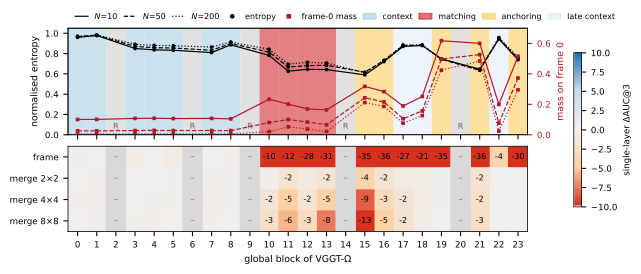
Figure 2 of the paper: regimes and tolerance in VGGT-Ω. Top: normalised entropy (black) and attention mass on frame 0 (red) per global block at 10, 50 and 200 frames; background: regime at N = 10. Bottom: ΔAUC@3 when one block alone uses frame attention or merging (ETH3D and 7-Scenes); numbers shown for drops of at least 1.5. Grey “R”/“–” columns: register-only blocks, never changed.
Context: averages over the scene
Blocks 0–8, except register-only 2 and 6; late context 17, 18, 22
Tolerates merging
In blocks 0–8 (entropy 0.81–0.98), each query spreads its attention almost evenly over all frames, and frame 0 gets only its uniform share (1.0–1.1×). These layers compute scene-wide averages, not correspondences. Blocks 17, 18 and 22 are diffuse again.
An average changes little when each image is summarised by fewer keys, so we merge every 4×4 group of patch keys into their mean (a non-reference frame then contributes 65 keys instead of 689). In the earliest context layers each image may even attend only to itself (frame attention); the late context layers tolerate merging but not frame attention.
Matching: matches points across images
Blocks 10–16, except register-only 14 (15 and 16 also anchor)
Must stay dense
Attention is concentrated (mean entropy 0.59–0.78; down to 0.25 for the most selective head), yet the most-attended frame receives only 0.26–0.48 of it: each query collects evidence from many frames.
Dropping or merging keys here destroys the correspondences: merging a single block in 10–16 costs up to 9 AUC@3 (Fig. 2), and applying RAWATTA-Fast's operators to matching blocks instead loses 85.08 worst-dataset AUC@3 (Tab. 5).
Anchoring: anchors on the first image
Blocks 19, 21, 23; partly 15, 16
Merging only if frame 0 keeps all its keys
52–62% of every query's attention goes to frame 0, 5–6× its uniform share at 10 frames, and 42–48% still does in blocks 19 and 21 at 200 frames. The target is a whole frame, the one whose coordinates the outputs use, and the effect is tied to the first position.
Merging is safe if frame 0 stays complete. Merging frame 0 together with the others in the single anchoring block 19 costs 2.7 AUC@3 on ETH3D, four times the cost of all RAWATTA-Fast approximations together.
Attention is not sparse: in no block of any of the three models does the heaviest frame hold more than 0.63 of the mass, and the effective number of attended keys is 9–83% of all keys. This is why block-sparse attention finds little to skip on VGGT-Ω (SparseVGGT: 7–8% effective sparsity, 1.17× faster), and why accelerators that merge or drop keys in matching layers lose accuracy. Numbers: Sec. 3 of the paper.
RAWATTA is training-free: every operator keeps every query and leaves the weights unchanged. A configuration is accepted only if the worst of five calibration datasets stays within a fixed accuracy budget, because errors of single layers do not simply add up and a loss on one dataset must not hide behind gains on others.
8-bit global attention
Global attention uses INT8 QK⊤ with key smoothing and per-block scales, following SageAttention, and FP8 (E4M3) P·V with FP16 accumulation in each 64-key block, folded into FP32 (SageAttention2++). Per global layer at 50 frames this takes 23.1 ms, against 50.0 ms for exact bf16 attention. VGGT-Ω's per-frame blocks keep bf16 attention.
16-bit only where the worst-case calibration check requires it
Which layers need more precision is the one choice the attention statistics do not predict, so the check decides. Starting from FP8 everywhere, layers get 16-bit P·V (34.2 ms per layer) in order of their single-layer gain until the worst calibration dataset is within −0.5 AUC@3 and −0.3 AUC@30. This stops after two layers, block 15 (matching and anchoring) and block 4 (context), and gives RAWATTA.
RAWATTA-Fast also approximates a few context and anchoring layers
A greedy search under the same check (budget −1 AUC@3 and −0.5 AUC@30, 49 configurations) may try every non-register layer and both cheaper operators. It accepts frame attention on blocks 0, 4, 5 and 4×4 merging on blocks 3 and 19, all of them context or anchoring layers; matching layers and frame 0 keep all their keys. Merged keys carry a +log c bias (proportional attention, as in ToMe and GPA-VGGT), which is exact for a uniform attention row. In the engine, frame-attention layers run on the bf16 kernel and merged layers on the 8-bit kernel. The schedule was fixed on one frame sample before any evaluation run: RAWATTA-Fast.
A native CUDA engine
PyTorch SDPA falls back to slower kernels when given the merge bias, and FlexAttention cannot take INT8/FP8 operands, so the model runs in a native engine: cuBLASLt bf16 matrix multiplications, our own attention kernels (INT8/FP8, 16-bit, merged, frame) and a static memory planner. With exact bf16 attention we call it the exact engine; comparing RAWATTA with the exact engine measures the method alone, and the exact engine against the released code measures the engine alone.
The regimes explain which operator each layer tolerates (Tab. 5 of the paper); the calibration check, not the regimes, picks the named settings. Sec. 4 of the paper.
At 50 images on a 12 GB RTX 4070 SUPER, RAWATTA is 2.08× faster than the released code: 1.61× from our CUDA engine and 1.29× from RAWATTA itself. At 200 images, RAWATTA alone is 1.66× faster than the exact engine, and RAWATTA-Fast 1.97×.
Official VGGT-Ω (released PyTorch code)3605 msbaseline
Exact engine (our CUDA engine, exact bf16 attention)2237 msengine: 1.61×
RAWATTA (8-bit attention, 16-bit on two layers)1734 msprecision: 1.29×
RAWATTA-Fast (+ approximated context and anchoring layers)1616 msschedule: 1.07×
At 200 images the exact engine takes 20.74 s, RAWATTA 12.51 s (1.66×) and RAWATTA-Fast 10.56 s (a further 1.19×, 1.97× in total), because global attention then takes 76% of the exact engine's time. Official VGGT-Ω runs out of memory at that length. Tab. 2 of the paper.
Operating points on VGGT-Ω
N = 50
N = 200
worst-dataset ΔAUC (N = 10)
Setting
ms
× official
s
× exact
Δ3 vs exact
Δ30 vs exact
Δ3 vs Official
cal.
Official VGGT-Ω
3605
1.00
OOM
–
–
–
0
–
Exact engine
2237
1.61
20.74
1.00
0
0
−0.86
–
RAWATTA
1734
2.08
12.51
1.66
−0.51 ±0.11
−0.24
−1.03
3/3
RAWATTA-Fast
1616
2.23
10.56
1.97
−0.80 ±0.17
−1.20
−1.14
2/3
threshold schedule
1544
2.33
9.39
2.21
−0.99 ±0.54
−1.23
−1.16
0/3
greedy search, budget −2
1547
2.33
9.51
2.18
−1.59 ±0.50
−0.75
−1.87
–
sensitivity-only greedy
1558
2.31
9.67
2.14
−0.91 ±0.25
−0.21
–
2/3
Swipe the table sideways to see all columns.
Tab. 1 of the paper (Official row: Tab. 1 caption and Tab. 4). Latency: full forward pass (trunk, camera and dense heads), one RTX 4070 SUPER (12 GB, CUDA 12.8), Mip-NeRF 360 kitchen at 512×336; exact engine and RAWATTA: mean of three timing sessions, RAWATTA-Fast: the 1616.4 ms session in which the rivals were timed (three-session mean 1611.8 ms; Supp. Tab. 23); × official: against Official VGGT-Ω at 3605 ms (out of memory at N ≥ 100); × exact: against the exact engine.
Accuracy: change in pose AUC@3 / AUC@30 on the worst of six evaluation datasets (ETH3D, CO3Dv2, RealEstate10K, 7-Scenes, NRGBD, TUM-dynamic) at N = 10, mean ± std of the per-seed worst over three frame-sampling seeds; differences below about 0.5 AUC@3 are seed noise. cal.: calibration samples (of three) passing the check.
Rows below the line are other schedules, not named settings; the sensitivity-only greedy search is post hoc and at 100/200 frames loses 3.42/2.10 on RE10K, against a worst-dataset loss of 1.20/1.03 for RAWATTA-Fast.
Against the released code, 0.86 of the worst-dataset AUC@3 change already comes from the exact engine. “Exact” means no attention approximation, not bit-identical to the released code: the engine runs bf16 weights and bf16 attention, while the released code keeps fp32 weights under bf16 autocast. The paper does not isolate the cause of the gap; the two differ only on ETH3D (0.8 AUC@3, Sec. 4.5). With 50, 100 and 200 frames per sequence (five datasets; ETH3D is too short), RAWATTA stays within 0.32 and RAWATTA-Fast within 1.20 AUC@3 of the exact engine on the worst dataset. Depth accuracy (δ1.25 and AbsRel) stays within 0.02 points and 0.0002 of Official for both settings. Sec. 5 of the paper.
Published accelerators on the same GPU
Method
s (N = 50)
×
worst Δ3
worst Δ30
s (N = 200)
Official VGGT-Ω
3.61
1.00
0
0
OOM
SparseVGGT†, default
3.08
1.17
−1.04 ±0.26
−0.51
OOM
CDF 0.90
3.06
1.18
−0.74*
−0.64
OOM
GPA-VGGT†, default
2.77
1.30
−3.14 ±1.08
−0.89
OOM
r = 0.5 on 9–23
2.85
1.27
−4.65*
−1.92
OOM
FastVGGT†
2.81
1.28
−21.19*
−9.17
OOM
SageAttention2‡, uniform
1.80
2.00
−2.47*
−1.10
13.57
frame 0–8, merge2 10–23‡
1.36
2.65
−37.89 ±0.00
−28.41
6.63
frame 0–8 only
1.56
2.31
−2.97 ±0.31
−0.82
9.72
GPA-style merge‡, RAWATTA-Fast's layers
1.65
2.18
−1.03 ±0.00
−1.25
11.13
Exact engine
2.24
1.61
−0.86 ±0.11
−0.30
20.74
RAWATTA
1.73
2.08
−1.03 ±0.00
−0.39
12.51
RAWATTA-Fast
1.62
2.23
−1.14 ±0.00
−1.13
10.56
Swipe the table sideways to see all columns.
Tab. 4 of the paper: accelerators on VGGT-Ω, same RTX 4070 SUPER, one timing session (exact engine, RAWATTA: three, 2237 ± 2, 1734 ± 1 ms). Worst ΔAUC against Official over six datasets as in Tab. 1, or seed 0 (*).
†Released code ported onto VGGT-Ω, poses only; ‡in our engine at RAWATTA's precision. ±0.00: ETH3D (one frame set) worst on every seed.
SparseVGGT skips little: it matches RAWATTA's worst-dataset accuracy (−1.04 vs −1.03) at 1.77× the latency. GPA-VGGT and FastVGGT merge or drop keys in the matching layers and lose 3.1 and 21.2 AUC@3; RAWATTA-Fast is 1.71× faster than GPA-VGGT and loses 2.0 points less, partly through our engine. Sec. 5.4 of the paper.
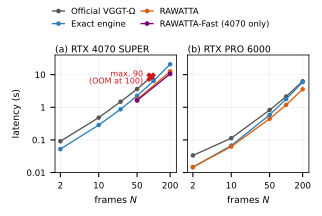
Supplementary Fig. 6: latency vs frames (kitchen, 512×336, full forward, exclusive GPU). (a) Official VGGT-Ω runs out of memory at 100 frames on 12 GB. (b) On Blackwell, the exact engine alone is barely faster than Official at 200 frames; the gain comes from the method.
12 GB, RTX 4070 SUPER. Official VGGT-Ω runs at most 90 frames (8.4 s) and runs out of memory from 100 frames on. RAWATTA and RAWATTA-Fast run 200 frames in 12.5 s and 10.6 s at a 9.7 GiB peak. At 200 frames, the single-pass exact engine scores 32.8 AUC@3 on 7-Scenes against 28.4 for chunked VGGT-Ω; the memory gain is the engine's. Sec. 5.5 of the paper.
96 GB, RTX PRO 6000 Blackwell (card exclusive, one fresh process per cell). RAWATTA is 1.86× and 1.76× faster than Official at 50 and 200 frames, the exact engine only 1.41× and 1.05×: on this card the gain is the method's. Our kernels ran as compute_89 PTX compiled by the driver, with no Blackwell-specific tuning. In single-pass probes with a 5-minute cap, Official reached 1390 frames, the exact engine 1310 and RAWATTA 1830. At 500 frames GPA-VGGT wins: as released (PyTorch) it takes 17.4 s at 32.20 AUC@3, against 22.9 s and 31.88 for RAWATTA, 34.7 s and 31.98 for SparseVGGT, and 39.3 s and 31.97 for Official (7-Scenes-long). Supplementary Sec. N and Tab. 18.
Point cloud and cameras reconstructed by the rawatta command-line tool. Frame 0, whose coordinates the outputs use, is drawn in orange. Drag to orbit, scroll or pinch to zoom, right-drag or two-finger drag to pan.
RAWATTA ships as a single rawatta binary (Rust + CUDA) in a Docker image. CUDA kernels are compiled at run time with NVRTC, so the host needs only Docker and an NVIDIA driver: no CUDA toolkit, Rust or Python. The rawatta binary and the image contain the VGGT-Ω port and are bound by the FAIR Noncommercial Research License (research use only).
RAWATTA, RAWATTA-FastCompute capability 8.9 or newer (sm_89+: Ada, Hopper, Blackwell, e.g. RTX 40xx/50xx, L4, L40, H100), for the FP8 tensor-core instructions. Run on Ada (RTX 4070 SUPER) and, in the paper, Blackwell sm_120 (RTX PRO 6000); Hopper (sm_90) and sm_100 are built and ptxas-checked but not yet run.
Exact engineCompute capability 8.0 or newer (sm_80+, e.g. A100, RTX 30xx, which cannot run RAWATTA). Built and bit-checked for sm_80+, not yet run on Ampere hardware.
HostLinux x86_64, Docker and an NVIDIA driver with CUDA 12.8 or newer (Docker reaches the GPU through the NVIDIA Container Toolkit). rawatta info reports which settings your GPU can run.
The commands below pull the published image ghcr.io/sezer-muhammed/rawatta:latest. To build it yourself instead, run docker build -f docker/Dockerfile -t ghcr.io/sezer-muhammed/rawatta:latest . in a clone of the repository (needs BuildKit, the default since Docker 23) and the commands work unchanged.
1. Request access to the VGGT-Ω weights
The VGGT-Ω weights are gated under the FAIR Noncommercial Research License. Sign in to Hugging Face and request access on the VGGT-Ω model page. Meta reviews requests by hand, which can take a while; until you are approved, the download is refused (HTTP 401/403). Then create a Read token (a fine-grained token needs “Read access to contents of all public gated repos you can access”). Save it with hf auth login (from pip install -U huggingface_hub; older versions: huggingface-cli login), which writes ~/.cache/huggingface/token, or, with no Python, save it there by hand without putting it on a command line:
mkdir -p ~/.cache/huggingface ~/.cache/rawatta
(umask 077; cat > ~/.cache/huggingface/token)   # paste the token, press Enter, then Ctrl-D
Create both folders yourself, as above: a folder that Docker creates for a mount belongs to root, and then neither the container, which runs as you, nor hf auth login can write to it.
2. Download and convert the weights (once)
# weights, once (host needs only Docker + NVIDIA driver; token file from 'hf auth login' or saved by hand)
docker run --rm --user "$(id -u):$(id -g)" -v ~/.cache/huggingface:/hf:ro -v ~/.cache/rawatta:/weights \
  --entrypoint download-weights ghcr.io/sezer-muhammed/rawatta:latest --token-file /hf/token --dir /weights
This downloads the official checkpoint, checks its SHA-256 and converts it to ~/.cache/rawatta/vggt_omega_1b_512.safetensors. The token is read from the file and never printed.
3. Reconstruct a folder of photos
Run this in the folder that holds your photos/; the results go to out/ next to it.
# reconstruct
docker run --rm --gpus all --user "$(id -u):$(id -g)" -v ~/.cache/rawatta:/weights:ro -v "$PWD":/work \
  ghcr.io/sezer-muhammed/rawatta:latest run --images photos --config rawatta --out out
The output folder holds cameras.json (per image: world-to-camera 3×4 in OpenCV convention and 3×3 intrinsics; the world frame is the first image's camera), extrinsics.npy, intrinsics.npy, depth.npy, conf.npy, a coloured point cloud points.ply, a COLMAP text model in colmap/ and timing.json. Use --video <file> instead of --images for a video, and --max-frames to cap the number of frames.
--config
What it runs
GPU
rawatta (default)
8-bit global attention, 16-bit P·V on blocks 4 and 15
sm_89+
rawatta-fast
8-bit global attention, 16-bit P·V on block 15; frame attention (bf16 kernel) on blocks 0, 4, 5; 4×4 merging (8-bit kernel) on blocks 3, 19
sm_89+
exact
exact engine: bf16 attention everywhere
sm_80+ (not yet run on Ampere)
Swipe the table sideways to see all columns.
Without Docker
Build the binary from source (Rust 1.99 or newer). At run time it needs the CUDA 12.x NVRTC and cuBLASLt libraries (12.8 or a newer 12.x: libnvrtc.so.12, libcublasLt.so.12; CUDA 13 libraries are not picked up). If rawatta info says they are not found, add the toolkit's lib64 (e.g. /usr/local/cuda-12.8/lib64) to LD_LIBRARY_PATH. tools/download_weights.sh needs curl, python3 3.10 or newer and numpy; it reads the token from ~/.cache/huggingface/token and writes the weights to ${XDG_CACHE_HOME:-~/.cache}/rawatta/, where rawatta looks by default.
git clone https://github.com/sezer-muhammed/rawatta && cd rawatta
cargo build --release -p rawatta-cli
tools/download_weights.sh
target/release/rawatta info
target/release/rawatta run --images photos --config rawatta --out out
No photos at hand? examples/buddha/fetch.sh downloads 34 CC BY 4.0 photos into data/examples/buddha/images.
Measured speed depends on the GPU: the numbers on this page come from an RTX 4070 SUPER and, where stated, an RTX PRO 6000 Blackwell. See the repository README for the configuration grammar, benchmarking and reproduction scripts.
Calibrated, not universal. Each model needs its own search. On VGGT-Ω, RAWATTA-Fast loses 2.2 AUC@3 on ETH3D at 50 frames against Official (1.65 against the exact engine; Supp. Tab. 21), and no schedule is best at every length. The regimes carry over to VGGT-1B and π³, but the thresholds of the threshold schedule do not: with VGGT-Ω's thresholds it loses 7.8 (VGGT-1B) and 8.8 (π³) worst-dataset AUC@3.
Coverage. Only ETH3D and NRGBD are unseen in calibration; the other four evaluation datasets share their source datasets, but not sequences, with calibration. Routing restricted to context or anchoring layers is untested.
Rivals and hardware. Published accelerators run as PyTorch ports; on a 96 GB Blackwell GPU, GPA-VGGT outperforms RAWATTA at 500 frames.
Speed, not accuracy. On 7-Scenes, adding context frames does not improve pose accuracy for any method, so the speed-up is useful for throughput and for sequences the released code cannot fit, not for pose accuracy on this benchmark.
Sec. 6 and Sec. 5.6 of the paper; supplementary Sec. F (Tab. 9).
@article{sezer2026rawatta,
  title   = {Training-Free Acceleration of Multi-View 3D Transformers via Regime-Aware Attention Approximation},
  author  = {Sezer, M. Izzet and Dikkaya, Sevval Belkis},
  journal = {arXiv preprint arXiv:2611.17629},
  year    = {2026}
}
RAWATTA builds on VGGT-Ω by Meta (FAIR; Wang et al., CVPR 2026): our engine is a native port of the VGGT-Ω model and runs its released weights. We acknowledge the use of these Research Materials, which Meta makes available under the FAIR Noncommercial Research License, and of DINOv3 materials (the patch embedder, blocks and RoPE of the backbone), which Meta makes available under the DINOv3 License. The quantised attention kernels follow SageAttention, SageAttention2 and SageAttention2++ (Zhang et al.). We thank the authors of SparseVGGT, GPA-VGGT and FastVGGT for releasing the code we compare against.